

From John Cena answering Kurt Angle’s challenge to Batista breaking free from Evolution, Brock Lesnar tearing through the roster, Eddie Guerrero reaching the mountaintop and Edge changing championship storytelling forever, WWE’s Ruthless Aggression Era was wrestling caught between two worlds.
WWE entered the Ruthless Aggression Era in 2002 with a new name, a divided roster and a mandate to create new stars. Logo source: Wikimedia Commons.
The WWE Ruthless Aggression Era occupies one of the strangest and most important places in professional wrestling history. It followed the cultural explosion of the Attitude Era, but it was not simply Attitude Era Part II.
The Monday Night War was over. WCW and the original ECW were gone. Steve Austin’s full-time run was nearing its conclusion, The Rock was increasingly being pulled toward Hollywood, and WWE suddenly controlled an enormous amount of wrestling talent without a national competitor forcing the company to react every Monday night.
The answer was reinvention.
WWE split its roster into competing television brands, elevated an extraordinary group of young wrestlers, emphasized athletic matches alongside soap-opera storytelling, introduced championships and concepts that still define the company, revived ECW, and gradually built John Cena, Batista, Randy Orton, Brock Lesnar and Edge into main-event stars.
The result was an era that could be excessive, experimental, violent, brilliant, ridiculous and unpredictable, sometimes during the same episode.
Before Ruthless Aggression: WWE Had Already Started Tearing Up the Blueprint
The transformation actually began before anyone said the words “ruthless aggression.”
On March 25, 2002, WWE conducted its first Brand Extension Draft (https://www.wwe.com/classics/history-of-wwe). The enormous roster assembled after WWE’s acquisition of WCW assets and the collapse of ECW was divided between Raw and SmackDown.
It was much more than an angle. Raw and SmackDown were being developed into separate wrestling ecosystems with their own rosters, feuds, presentation and eventually championships.
_Logo.png)

Then came another symbolic break with the past.
On May 6, 2002, World Wrestling Federation Entertainment officially announced that it was changing its name to World Wrestling Entertainment.
WWF became WWE.
The company had a new name. Raw and SmackDown had separate identities. Its previous generation of megastars was beginning to thin out.
What WWE still needed was a mission statement.
Two Words: Ruthless Aggression
That arrived in June 2002.
Vince McMahon appeared before the roster on Raw and demanded that somebody step forward with the quality he believed WWE needed: ruthless aggression.
Three days later, on the June 27, 2002 episode of SmackDown, Kurt Angle issued an open challenge.
An unfamiliar young wrestler walked through the curtain.
John Cena had arrived.
When Angle asked what quality made Cena believe he could compete with an Olympic gold medalist, Cena delivered the phrase that would become permanently attached to an entire period of WWE history.
Ruthless aggression.
Cena slapped Angle across the face and fought him with enough intensity that the loss hardly mattered. WWE had created one of the most effective introductory scenes in wrestling history: established world-class wrestler meets unknown prospect, prospect refuses to be intimidated, and the audience immediately understands that someone new has arrived.
Cena became the perfect opening image for the era.
The 2002 Rookie Class Was Ridiculous
Cena wasn’t arriving alone.
The developmental pipeline surrounding Ohio Valley Wrestling produced a collection of future main-event talent that looks almost fictional in retrospect.
- John Cena
- Brock Lesnar
- Randy Orton
- Batista
Those four men would eventually accumulate world championships, WrestleMania main events, Royal Rumble victories, Hollywood careers and decades of influence over WWE.
More importantly, they didn’t all become stars the same way.
Lesnar was presented as a monster immediately. Cena struggled before discovering the Doctor of Thuganomics character. Orton evolved into the smug Legend Killer. Batista initially appeared as Reverend D-Von’s imposing enforcer before Evolution finally gave him the environment in which he looked like a future world champion.
The Ruthless Aggression Era was therefore not merely WWE replacing Steve Austin and The Rock with somebody else. It was WWE running several experiments simultaneously and discovering which performers could become the next generation.
Brock Lesnar Didn’t Climb the Ladder. He Broke It.
No wrestler illustrated the new philosophy faster than Brock Lesnar.
Lesnar debuted on WWE television in 2002 with Paul Heyman and was immediately portrayed as an athletic catastrophe.
The combination was unusual even by professional wrestling standards: heavyweight size, amateur wrestling credentials, explosiveness and speed that seemed incompatible with his frame.
By SummerSlam 2002, the experiment had become a coronation.
Lesnar defeated The Rock to win the WWE Championship at age 25, becoming the youngest WWE Champion in history at that time.
WWE did not spend years cautiously preparing him.
It pointed him directly at the top of the card.
Lesnar entered programs with The Undertaker, Kurt Angle, Big Show, Eddie Guerrero and John Cena. His matches with Angle in particular helped define SmackDown’s identity as a show where serious athletic wrestling could coexist with WWE spectacle.
Even Lesnar’s abrupt departure in 2004 became part of the era’s character. Ruthless Aggression rarely felt settled.
SmackDown Became the Wrestling Show
If Raw often represented star power, authority figures and larger-than-life drama, early Ruthless Aggression-era SmackDown developed a reputation as WWE’s wrestling laboratory.
Paul Heyman’s creative influence helped center the program around a collection of performers later remembered as the SmackDown Six.
- Kurt Angle
- Edge
- Eddie Guerrero
- Chavo Guerrero
- Rey Mysterio
- Chris Benoit
The combination created an almost inexhaustible match generator. Singles matches became tag matches. Tag rivalries became championship programs. Technical wrestling collided with lucha libre, power wrestling and character-driven storytelling.
Rey Mysterio’s WWE arrival was especially important. WWE had possessed smaller wrestlers before, but Mysterio’s presentation demonstrated that spectacular cruiserweight offense could be integrated directly into major television stories.

The era’s reputation for in-ring quality owes an enormous debt to this version of SmackDown. Angle, Guerrero, Mysterio and Edge in particular would remain fundamental pieces of WWE long after the original SmackDown Six combinations disappeared.
Eddie Guerrero Became the Heart of SmackDown
Few stories better demonstrate the possibilities of Ruthless Aggression than Eddie Guerrero.
Guerrero was already regarded as an elite wrestler, but the era allowed his personality to expand beyond the expectations traditionally placed on a smaller performer.
Latino Heat became charismatic, funny, dangerous and emotionally vulnerable. His “Lie, Cheat and Steal” persona somehow made dishonesty lovable.
Then WWE trusted him with the biggest prize on SmackDown.
At No Way Out on February 15, 2004, Guerrero defeated Brock Lesnar to win the WWE Championship.

Guerrero’s championship victory mattered because it demonstrated that the main event did not have to fit one physical template.
Charisma, connection and elite wrestling ability could overcome the conventional expectations surrounding a WWE Champion.
His death in November 2005 at only 38 years old became one of the era’s most painful dividing lines. Eddie’s influence continued through Rey Mysterio, Chavo Guerrero and generations of wrestlers who modeled pieces of their work after him.
Evolution Was Ruthless Aggression in Faction Form
While SmackDown built its identity around athletic depth, Raw developed one of the defining power structures of the decade.
Evolution brought together Ric Flair, Triple H, Randy Orton and Batista.
The concept was elegant: Flair represented wrestling’s past, Triple H its present, and Orton and Batista its future.
Evolution accomplished two things simultaneously.
It reinforced Triple H as Raw’s central antagonist while placing Orton and Batista in main-event surroundings every week.
They dressed like stars, entered with stars, wrestled against stars and gradually began to look as if they belonged there.
Randy Orton developed the Legend Killer identity, targeting established names and becoming World Heavyweight Champion at SummerSlam 2004.

His championship victory immediately created another story.
Evolution turned on him.
The faction designed to showcase the future had become frightened by its own creation.
Batista’s Thumbs Down Changed WWE
Batista’s transformation took longer, and that made it even more satisfying.
By early 2005, Batista had quietly become one of the most popular performers in the company.
The audience could see where the story was heading. Triple H increasingly viewed Batista as a threat. Batista increasingly understood that his supposed mentor was manipulating him.
Then came one of Raw’s greatest contract-signing segments.
Batista appeared ready to leave Raw and challenge SmackDown’s WWE Champion. Instead, he gave Triple H the famous thumbs down and chose him as his WrestleMania opponent.
It was the payoff to months of patient storytelling.
At WrestleMania 21, Batista defeated Triple H for the World Heavyweight Championship.

That same night, John Cena defeated JBL for the WWE Championship.
WrestleMania 21 therefore became one of the clearest generational handoffs of the Ruthless Aggression Era.
Cena and Batista entered the show as challengers.
They left holding WWE’s two major world championships.
WrestleMania 21 Was the Night WWE’s Future Arrived
The significance of WrestleMania 21 extends beyond Cena and Batista.
Edge won the first Money in the Bank Ladder Match, introducing a concept that would transform championship storytelling.
Instead of simply earning a scheduled title match, the Money in the Bank holder possessed a permanent threat.
A champion could survive a war, barely stand up, and then hear someone else’s entrance music.
Edge turned that possibility into reality at New Year’s Revolution 2006.
John Cena survived an Elimination Chamber match and retained the WWE Championship.
Then Edge appeared with the briefcase.
Edge defeated the exhausted Cena and became WWE Champion in the first successful Money in the Bank cash-in.
It instantly established the briefcase as one of WWE’s most powerful storytelling devices and completed Edge’s transformation into the Rated-R Superstar and Ultimate Opportunist.
John Cena Became the Center of WWE
Cena’s transformation during the era was remarkable precisely because his original babyface presentation did not immediately work.
The breakthrough came when Cena began rapping.
The Doctor of Thuganomics character gave him something the generic prospect lacked: voice.
Cena could humiliate opponents verbally, improvise, work a hostile crowd and turn his personality into merchandise.
By 2004, the United States Championship had become part of his rise.
By WrestleMania 21, he was ready for JBL and the WWE Championship.

Cena’s championship run also changed the audience itself.
Children increasingly adored him. A vocal percentage of adult wrestling fans rejected him. Arenas sometimes became divided into competing chants before Cena had even locked up.
That polarization became part of the attraction.
WWE had found its new franchise player, but unlike Hulk Hogan, Steve Austin or The Rock, Cena could simultaneously function as the company’s top hero and the wrestler half the building desperately wanted to see lose.
The Cena dynamic would survive far beyond the Ruthless Aggression Era.
The Women’s Division Was Complicated, but Its Best Wrestlers Kept Breaking Through
Any serious history of Ruthless Aggression has to acknowledge the contradiction surrounding WWE’s women’s division.
The era frequently placed women in presentation built around sex appeal, gimmick contests and material that has aged badly.
At the same time, several women were steadily proving that the audience would invest in serious women’s wrestling when given the opportunity.
Trish Stratus, Lita, Victoria, Molly Holly, Mickie James, Melina and others helped expand what WWE’s women’s matches could look like.
One of the defining television moments came on December 6, 2004.
Trish Stratus and Lita wrestled for the Women’s Championship in the main event of Monday Night Raw.
It was significant precisely because WWE rarely allowed women to occupy that position.
The match demonstrated that a women’s championship rivalry could close the company’s flagship television program on wrestling and personal conflict rather than novelty.
Later generations would receive more time, stronger institutional support and eventually WrestleMania main events.
But the women of Ruthless Aggression were part of the bridge that made those possibilities easier to imagine.
Rey Mysterio Proved Size Didn’t Determine Connection
Rey Mysterio’s rise was another rejection of conventional WWE assumptions.
After Eddie Guerrero’s death, Mysterio’s connection with the audience became intertwined with grief, friendship and tribute.
He entered the 2006 Royal Rumble at No. 2 and won the match, earning a World Championship opportunity at WrestleMania 22.
At WrestleMania, Mysterio defeated Kurt Angle and Randy Orton to become World Heavyweight Champion.

Mysterio’s championship run was imperfectly booked, but the image mattered.
A wrestler dramatically smaller than the traditional WWE heavyweight prototype had reached the top championship position through athleticism and an extraordinary emotional bond with fans.
ECW Came Back From the Dead
Another defining feature of the era was WWE’s complicated relationship with wrestling’s recent past.
The company had acquired ECW’s assets after the promotion folded, but nostalgia for the original Extreme Championship Wrestling only intensified.
That led to ECW One Night Stand 2005, a reunion event that demonstrated how much affection remained for the promotion.
The reaction was strong enough that the experiment expanded.
By 2006, WWE resurrected ECW as a third brand.
The moment that best captured the collision between old ECW culture and modern WE came at One Night Stand 2006, when Rob Van Dam challenged John Cena for the WWE Championship inside the Hammerstein Ballroom.
The building treated Cena as an invading enemy.
RVD won the WWE Championship after interference from Edge and soon held both the WWE and ECW championships.

WWE coverage of Rob Van Dam vs. John Cena
The revived weekly ECW would eventually evolve into something very different from Paul Heyman’s original promotion, but its existence demonstrates how aggressively WWE experimented during Ruthless Aggression.
Raw, SmackDown and ECW were now three different environments under one company umbrella.
The Wrestling Looked and Felt Different
Ruthless Aggression also had a visual language that instantly separates it from both the Attitude and PG eras.
The production was metallic, industrial and saturated.
Entrance stages were enormous. TitanTrons mattered. Theme music helped define wrestlers before they reached the ring. Championship belts became central pieces of character presentation.
The World Heavyweight Championship returned in 2002 after Brock Lesnar became exclusive to SmackDown, giving Raw its own top championship.
John Cena eventually replaced the traditional WWE Championship design with the spinner championship, turning the belt itself into part of his persona.
The shows also retained a harder edge.
Blood remained common in major matches. Hell in a Cell, Elimination Chamber, ladder matches and hardcore stipulations were presented as genuinely dangerous attractions.
Batista and Triple H’s Hell in a Cell match at Vengeance 2005, Undertaker’s rivalries, Edge’s increasingly violent main events and the rise of the Elimination Chamber all contributed to a period in which major matches were frequently designed to look punishing.
The Era Created WWE’s Modern Playbook
Some of WWE’s most durable concepts either began or became institutionalized during this period.
- The WWE Draft turned brand movement into an annual storyline event.
- Money in the Bank created a completely new mechanism for championship changes.
- The Elimination Chamber became one of WWE’s signature match structures.
- Separate Raw and SmackDown rosters allowed WWE to manufacture internal competition.
- The World Heavyweight Championship gave the second brand a visually distinct world title.
- ECW as a third brand became an experimental space for veterans and developing talent.
- Developmental wrestling became increasingly important as WWE searched systematically for its next generation.
Those ideas survived because they solved problems WWE would continue to face: how to introduce wrestlers, how to refresh rosters, how to create unexpected champions and how to make one enormous company feel like several different wrestling worlds.
When Did the Ruthless Aggression Era End?
Unlike a championship reign, wrestling eras rarely end with a bell.
There is no universally agreed final date for Ruthless Aggression. The transition happened gradually.
By 2007 and 2008, the roster had already changed considerably.
Eddie Guerrero had died. Kurt Angle had left WWE. Brock Lesnar’s first run was long over. Trish Stratus and Lita had retired from full-time competition.
Cena, Batista, Edge and Orton were no longer prospects.
They were established main-event stars.
The clearest dividing line arrived in 2008, when WWE transitioned its programming fully toward a TV-PG presentation.
That shift affected language, violence, blood, sexual content, sponsorship strategy and the company’s broader image.
The anarchic early-2000s atmosphere slowly gave way to a more deliberately family-oriented WWE.
Ruthless Aggression had done its job.
It had found the next generation.
Who Defined the Ruthless Aggression Era?
There isn’t one correct answer, which may be the era’s greatest strength.
John Cena became its franchise player. Batista embodied its slow-burn creation of a main-event star. Brock Lesnar represented its obsession with legitimate athleticism and immediate impact. Randy Orton became one of its youngest long-term investments. Triple H was the central antagonist around whom much of Raw was constructed. Edge mastered the era’s increasingly opportunistic championship storytelling. Eddie Guerrero represented the emotional and athletic soul of SmackDown. Rey Mysterio shattered assumptions about what a WWE world champion had to look like. Kurt Angle was one of its most consistently elite in-ring performers. Trish Stratus and Lita pushed against the limitations imposed on WWE’s women’s division.
That depth is why Ruthless Aggression nostalgia has lasted.
The Legacy of Ruthless Aggression
The Attitude Era will probably always possess the louder mythology.
Austin. Rock. DX. McMahon. Monday-night ratings warfare. Wrestling invading pop culture.
Ruthless Aggression had a different job.
It had to figure out what happened after wrestling’s boom.
WWE suddenly had no WCW breathing down its neck. Its biggest stars were aging, injured, leaving or entering Hollywood.
The roster was enormous.
The wrestling audience was changing.
Instead of producing another Steve Austin, WWE produced Cena, Batista, Orton, Lesnar and Edge.
Instead of a single roster, it created Raw and SmackDown as competing brands.
Instead of relying entirely on heavyweight archetypes, it elevated Eddie Guerrero and Rey Mysterio.
Instead of one predictable route to a championship, it invented Money in the Bank.
And instead of preserving the style that had won the Monday Night War, WWE spent years throwing ideas against the wall with astonishing force.
Some worked.
Some spectacularly did not.
But that’s precisely why the era remains so fascinating.
Ruthless Aggression was WWE rebuilding itself in public.
It was the sound of one generation leaving while another kicked the door open.
Essential Ruthless Aggression Era Matches and Moments
- John Cena vs. Kurt Angle — SmackDown, June 27, 2002
- The Rock vs. Brock Lesnar — SummerSlam 2002
- Kurt Angle vs. Brock Lesnar — WrestleMania XIX
- Eddie Guerrero vs. Brock Lesnar — No Way Out 2004
- Trish Stratus vs. Lita — Raw, December 6, 2004
- Batista vs. Triple H — WrestleMania 21
- John Cena vs. JBL — WrestleMania 21
- Batista vs. Triple H, Hell in a Cell — Vengeance 2005
- Edge cashes in Money in the Bank on John Cena — New Year’s Revolution 2006
- Rey Mysterio vs. Kurt Angle vs. Randy Orton — WrestleMania 22
- John Cena vs. Rob Van Dam — ECW One Night Stand 2006
- Batista vs. The Undertaker — WrestleMania 23
- John Cena vs. Randy Orton — SummerSlam 2007
Explore More Wrestling History
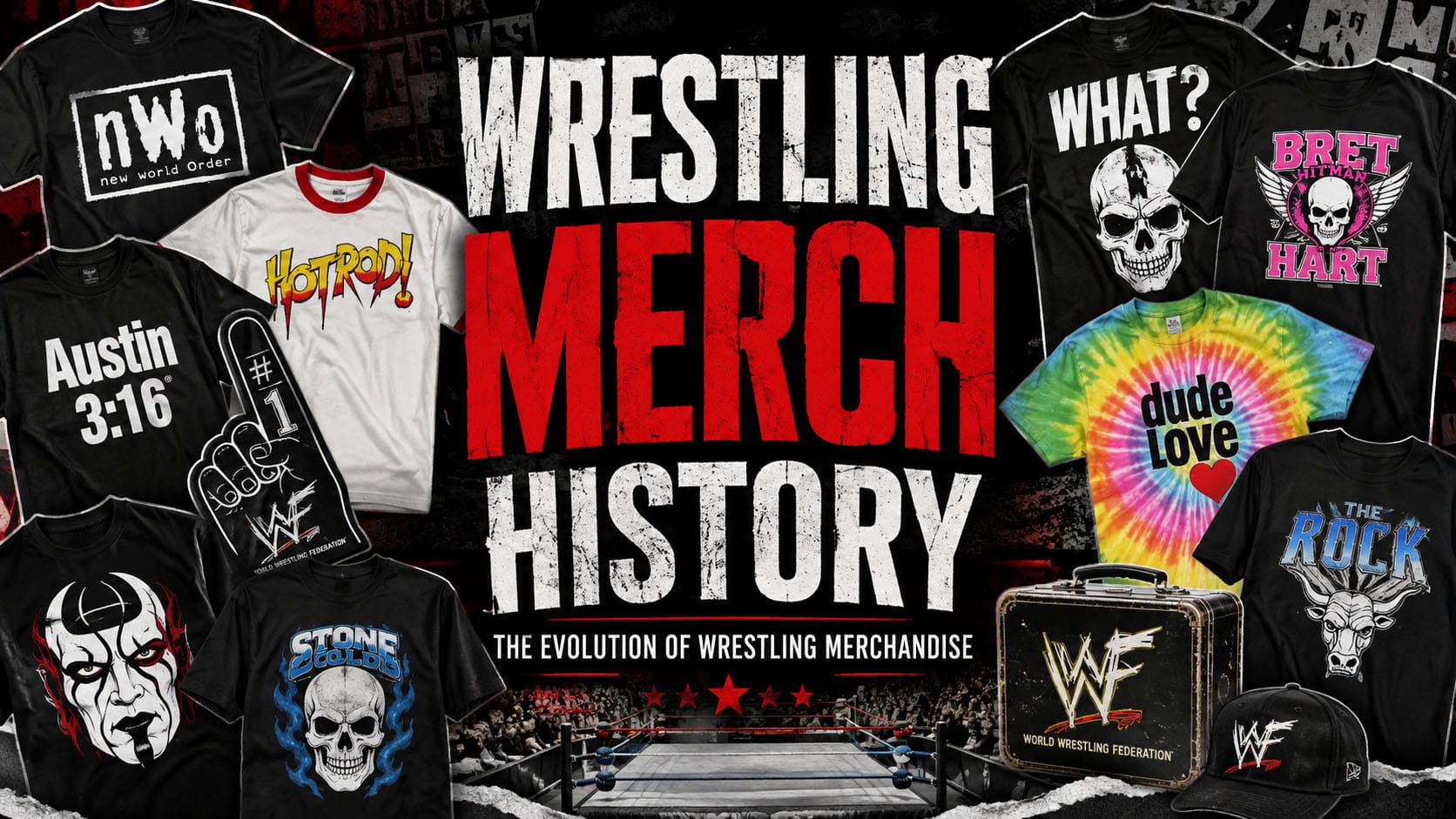
For more classic wrestling stories, retro merchandise and deep dives into the eras that created today’s WWE, explore WrestlingTees.net:
WWE, Raw, SmackDown, ECW and associated wrestler names and logos are trademarks of their respective owners. Historical third-party images should be used according to the licensing information listed on their individual Wikimedia Commons file pages.